
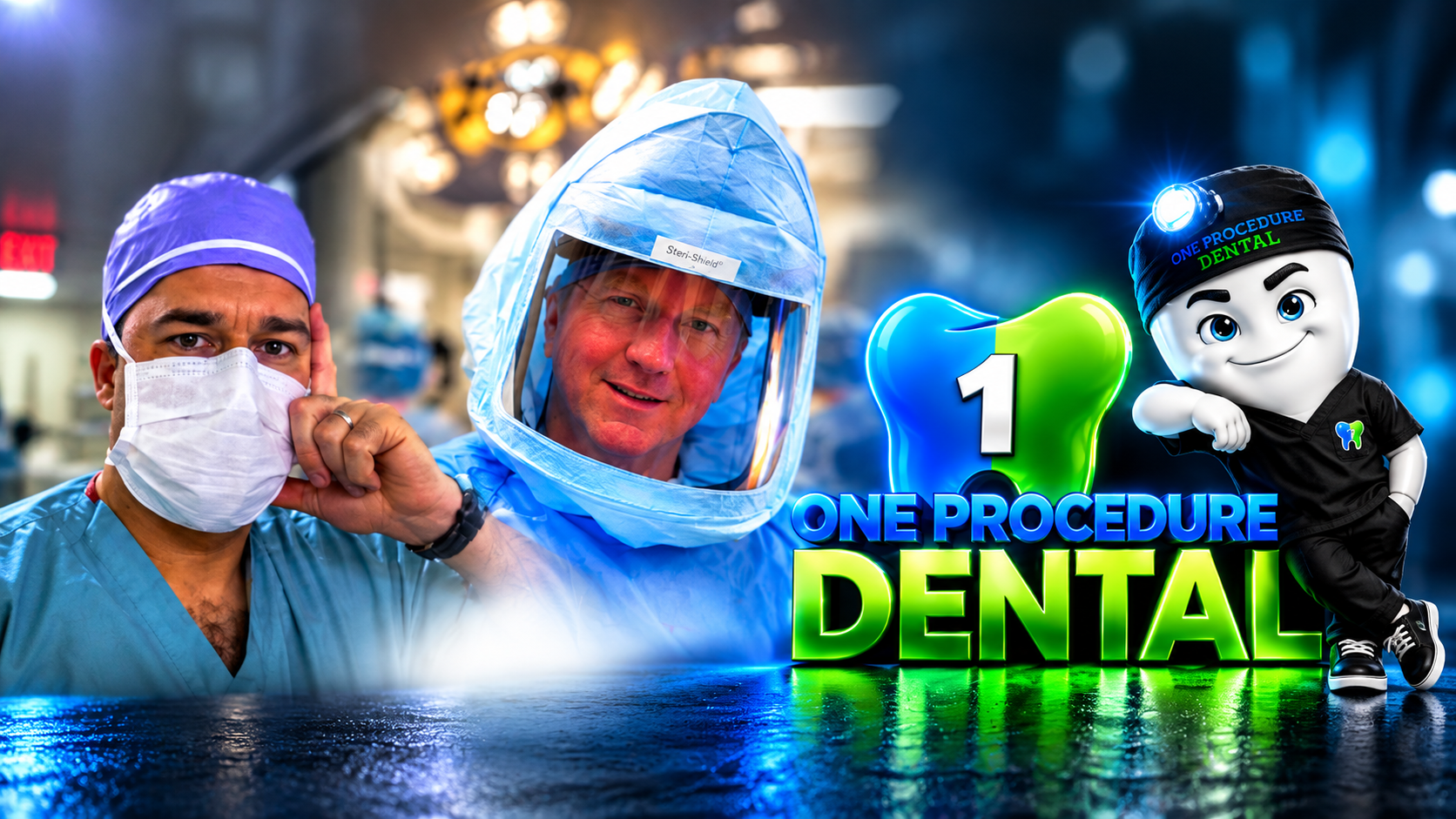
The Journey of One Procedure
My professional career started in a physical therapy clinic. Today, I'm launching a new version of One Procedure Dental.
Who would have thought that a career spanning physical therapy, practice management, medical devices, marketing, and medical consulting would eventually lead me here—to dental consulting?
Looking back, though, it makes perfect sense.
The similarities between what I believed then and what I believe today are remarkable. I just didn't know where it was all leading.
It Started With Shoulders
Toward the end of my physical therapy career, I developed a strong interest in shoulder rehabilitation.
I loved treating shoulder patients.
At the same time, I was building a relationship with a young fellowship-trained orthopedic surgeon, Dr. Macy, who would become not only a mentor, but an incredible friend.
I was managing a physical therapy practice, still treating patients part-time, and helping market three clinics. Within those clinics, we began developing specialties that many of our competitors didn't have.
Without realizing it, I was learning how to market something specific instead of trying to market everything.
And it worked.
At the same time, I was becoming increasingly knowledgeable about shoulders. I was learning from Dr. Macy across the street, treating his patients, and building a relationship that would eventually change the direction of my career.
Long before social media, algorithms, Google reviews, or digital marketing became part of our everyday vocabulary, I was learning a lesson that has stayed with me:
When you focus attention around something specific, people begin to know you for it.
Then I Walked Into an Operating Room
Eventually, I left an amazing physical therapy career to enter a business I knew almost nothing about: medical devices.
There was one thing working in my favor.
I knew shoulders.
I knew the shoulder surgeons. I understood the patients. I understood the procedures from the rehabilitation side. And I had a great product to sell.
There was just one small problem.
I'd never stepped foot in an operating room.
As luck would have it, I eventually became Dr. Macy's sales representative.
The relationship changed, but the focus didn't.
We were doing shoulders.
He taught me the operating room. I took notes. I learned his procedures. I learned every step, every instrument, and eventually even knew which suture he would need and when he would need it.
We became a team.
What started with treating shoulder patients in physical therapy evolved into a medical-device career that included more than 100 shoulder replacements a year and lasted more than a decade.
Once again, my career was growing around something very specific.
One procedure.
Starting Over in South Florida
Eventually, I left Vermont and Dr. Macy for a position with a major medical-device company.
I moved to South Florida as a shoulder specialist.
I knew shoulders.
I knew how to sell.
I knew how to market.
What I didn't know was where half the doctors were located—or, for that matter, where the hospitals were.
I was essentially starting over in one of the most competitive markets in the country.
But once again, I had focus.
I wasn't trying to become everything to everyone.
I had a product. I had expertise. I had a market to learn.
And I knew exactly where to put my attention.
Then I Started Seeing the Same Pattern Everywhere
After leaving medical-device sales, I moved into consulting and began working with medical practices, physical therapy practices, chiropractic practices, and pain clinics.
Something kept standing out to me.
Practices wanted to grow everything at once.
That never made sense to me.
I'd already seen what happened when a physical therapy practice developed specific specialties. I'd spent years working alongside surgeons who became known for specific procedures. I'd built my own career around becoming highly knowledgeable about one part of orthopedics.
Why should practice growth be any different?
If you're exceptionally trained in a procedure, let people know.
If it's something you love doing, let people know.
If it's something you want to grow, put some attention behind it.
You don't have to stop doing everything else.
You simply don't have to try to grow everything at the same time.
When social media entered the picture, my belief became even stronger. Practices suddenly had more ways than ever to communicate with patients—but that also meant more noise.
Everyone was talking.
Everyone was posting.
Everyone was marketing.
And everyone seemed to be saying everything.
I kept coming back to the same thought:
Focus the attention.
Then Someone Said, “You Should Think About Dental.”
At the time, dental wasn't part of my plan.
In fact, I was days away from launching a new website focused on marketing and social media for medical practices when a friend said something simple:
“You should think about dental.”
A few conversations followed.
Then a website.
Then another version of the business.
And eventually, a realization.
The things I had learned throughout my career weren't specific to orthopedics, physical therapy, medical devices, or medical practices.
The same principles applied to dentistry.
General dentists perform a tremendous variety of procedures. But that doesn't mean every procedure has to receive the same attention at the same time.
Maybe there's a procedure you love performing.
Maybe you've invested heavily in training for something new.
Maybe there's a procedure you're already good at, but patients in your community don't know you for it.
Or maybe a procedure simply isn't growing the way you believe it should.
Pick one.
Then figure out why.
That's Where One Procedure Dental Changed
My original thinking was heavily centered around procedure-specific marketing and social media.
But experience taught me something important.
Marketing isn't always the problem.
Sometimes the website isn't connecting.
Sometimes Google isn't telling the same story as the practice.
Sometimes the competition is stronger than expected.
Sometimes the phones, scheduling, financing, case acceptance, reviews, patient experience, social presence, or market itself is affecting growth.
And sometimes the smartest decision may be not to invest more money into a procedure yet.
That realization changed One Procedure Dental.
I stopped thinking first about marketing and started thinking like the dentists I wanted to help.
A dentist doesn't prescribe treatment before diagnosing the patient.
So why would I prescribe marketing before diagnosing the procedure?
Diagnosis. Procedure Protocol. Treatment.
Today, the One Procedure Dental approach is simple.
You pick the procedure. We diagnose the opportunity.
We look at what's working, what's not working, what's connecting, and what's missing.
We evaluate the practice, local market, competition, Google presence, website, social presence, patient journey, positioning, and the other factors affecting that specific procedure.
That becomes the Diagnosis.
From that diagnosis, we create a Procedure Protocol—a step-by-step plan built around that procedure, that practice, and that market.
Then comes Treatment.
And here's an important distinction:
The dentist owns the protocol.
If the practice already has a marketing company, website provider, social-media agency, or internal team, keep them.
Give them the diagnosis.
Give them the protocol.
Give good people a clearer direction.
One Procedure Dental doesn't need to replace everyone around the practice. Our job is to determine what needs to happen and create the plan to make it happen.
Looking Back, It Was Always One Procedure
It's funny how a career makes more sense when you look backward.
Physical therapy taught me the value of developing expertise.
Dr. Macy taught me what it meant to truly understand a procedure.
Medical devices taught me how expertise, relationships, education, and business intersect.
South Florida taught me how to compete in a crowded market.
Consulting taught me that growth problems are rarely as simple as they appear.
And dental brought all of it together.
One Procedure Dental might be my greatest work combined into one.
Not because I suddenly discovered some revolutionary marketing trick.
Quite the opposite.
It's because I've spent much of my professional career learning variations of the same lesson.
You don't have to be everything to everyone.
You don't have to grow everything at once.
Sometimes you just need to decide what matters, understand what's standing in the way, and put the right plan behind it.
It took me a career spanning several industries to recognize the pattern.
Looking back now, it seems obvious.
It was always one procedure.