The Practice Wasn't Missing Marketing. It Was Missing Alignment.
How an established dental practice revealed more than 50 overlooked opportunities despite years of substantial marketing investment.
What happens when a highly successful dental practice spends hundreds of thousands of dollars on marketing, ranks prominently on Google, and attracts patients from across the country—yet still has fundamental problems with its digital presence?
You might assume that an organization operating at this level would have everything working together.
That's exactly what made one of my previous healthcare consulting engagements so revealing.
During my initial assessment of an established, high-volume wisdom tooth practice, I identified more than 50 inconsistencies, disconnected elements, and overlooked opportunities affecting how the organization presented itself to prospective patients.
The practice wasn't struggling to establish credibility. It already had an impressive clinical reputation, extensive procedure experience, and significant market visibility.
The problem was that its digital presence wasn't consistently communicating those advantages.
And years of substantial marketing investment hadn't addressed many of the underlying issues.
When a Successful Practice Has an Underperforming Digital Presence
One of the first things I noticed was a disconnect between the organization's physical advertising and its online identity.
Billboards, buses, and other physical marketing materials promoted one brand, while the website and social media emphasized another.
Imagine a prospective patient seeing a billboard, remembering the name, and searching for the practice online—only to encounter a different identity.
That inconsistency creates unnecessary confusion at a critical point in the patient's decision-making process.
But the brand confusion was only the beginning.
Google Business listings contained inaccurate or outdated information. Older photographs and pricing remained visible online. Some website connections were broken, and social media platforms used inconsistent branding and imagery.
In one example, older promotional materials displayed a $999 price while the updated price was $1,099.
That may seem like a small detail, but imagine the frustration of a patient who arrives expecting one price and encounters another.
These issues weren't isolated. They existed across multiple platforms that prospective patients might encounter while researching the same procedure.
The organization was investing heavily in attracting attention without ensuring that the information supporting that attention was accurate, consistent, and connected.
The Most Surprising Discovery: What the Practice Wasn't Telling Patients
Beyond the technical and branding inconsistencies, I discovered something even more important.
The practice possessed competitive advantages that many dental organizations would love to have.
It had extensive experience performing wisdom tooth procedures. It had developed a strong reputation, and patients traveled from across the country to receive treatment.
Yet these distinctions weren't consistently communicated through the website and social media.
Think about that for a moment.
A prospective patient comparing dental providers might never discover some of the strongest reasons to consider this particular practice.
The organization also had opportunities to connect more directly with its surrounding community, including nearby universities, more than 20 high schools, students, and parents.
These audiences were particularly relevant to wisdom tooth removal, but they hadn't been systematically addressed through the digital communication strategy.
The issue wasn't a lack of clinical expertise or marketing expenditure.
It was the gap between what made the practice exceptional and what prospective patients could actually discover about it.
Following the Natural Patient Journey
When evaluating a dental practice, I like to consider the experience from the patient's perspective.
Imagine someone searching Google for "wisdom teeth near me."
They discover a practice, review its Google Business Profile, visit its website, and perhaps explore its Facebook, Instagram, or YouTube content.
Along the way, they're looking for answers.
Is this provider experienced? What will the procedure involve? How much will it cost? Will it hurt? What does recovery look like? Why should I choose this practice instead of another?
Each digital touchpoint offers an opportunity to answer those questions and build confidence.
But when information is outdated, branding changes between platforms, and important questions go unanswered, that journey becomes unnecessarily complicated.
A prominent Google ranking can help a patient discover a practice.
It doesn't guarantee that the information they discover afterward will give them the confidence to make an appointment.
That distinction became central to my diagnosis.
Introducing the 8-Pillars of Patient Communication
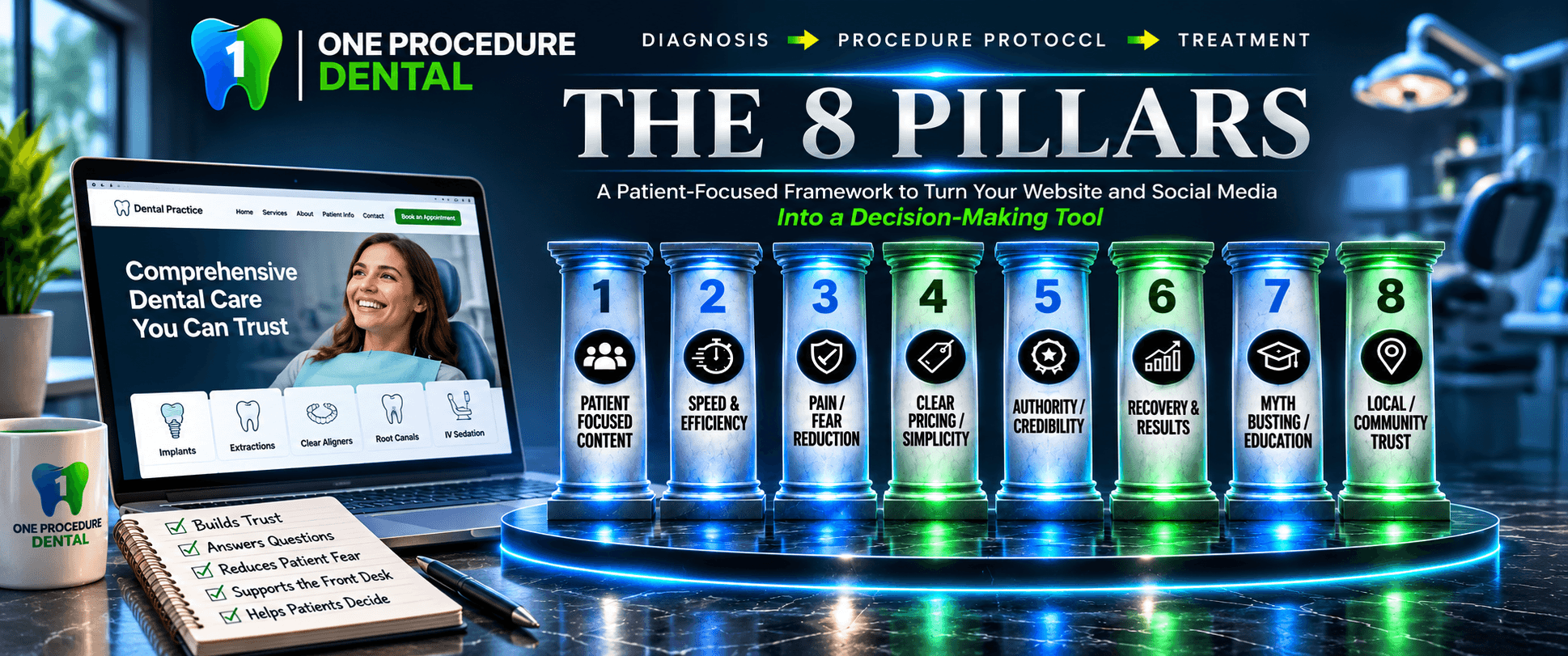
Rather than simply increasing posting frequency, I developed a coordinated content strategy around eight areas of patient communication.
For this wisdom tooth practice, the framework addressed:
Mom-Focused Content
Speed & Efficiency
Pain / Fear Reduction
Clear Pricing / Simplicity
Authority / Credibility
Recovery & Results
Myth Busting / Education
Local / Community Trust
Each pillar addressed a specific question, concern, or decision-making factor relevant to prospective patients and their families.
For example, instead of repeatedly promoting the practice's name, content could explain what parents should expect when their teenager needs wisdom teeth removed.
Rather than relying exclusively on general promotional messages, videos could address recovery, treatment expectations, common misconceptions, and the experience of choosing a specialized provider.
The practice's extensive clinical experience and national patient draw could become meaningful points of differentiation.
Local content could also help connect the practice with nearby families, students, and communities.
The objective wasn't simply to produce more content. It was to make the content more useful to the people considering the procedure.
This approach helped connect the organization's clinical strengths with the questions patients were already asking.
From Diagnosis to Protocol to Action
Identifying problems is only the beginning.
The next challenge is deciding what needs attention, establishing priorities, and implementing improvements.
During this engagement, I worked through an earlier version of the methodology that would eventually become the foundation of One Procedure Dental:
Diagnosis → Protocol → Action.
The Diagnosis identified the inconsistencies, communication gaps, and overlooked opportunities.
The Protocol established a coordinated strategy for correcting information, strengthening branding, developing patient-centered content, and improving the connections between digital platforms.
And in this particular engagement, I personally participated in the Action.
That work included producing extensive original creative content, developing educational videos, restoring regular social media activity, improving visual consistency, and coordinating website recommendations and corrections with the development team.
The initial progress documentation alone recorded more than 40 original creative designs and 10 completed Reels. Additional content and implementation work followed.
Not every recommended correction was completed. Some required organizational decisions, access, or approvals outside my direct control.
But the work moved well beyond presenting an assessment.
It involved putting the strategy into practice.
What Happened to Facebook's Organic Visibility?
One of the most interesting parts of this engagement was reviewing the organization's historical social media performance.
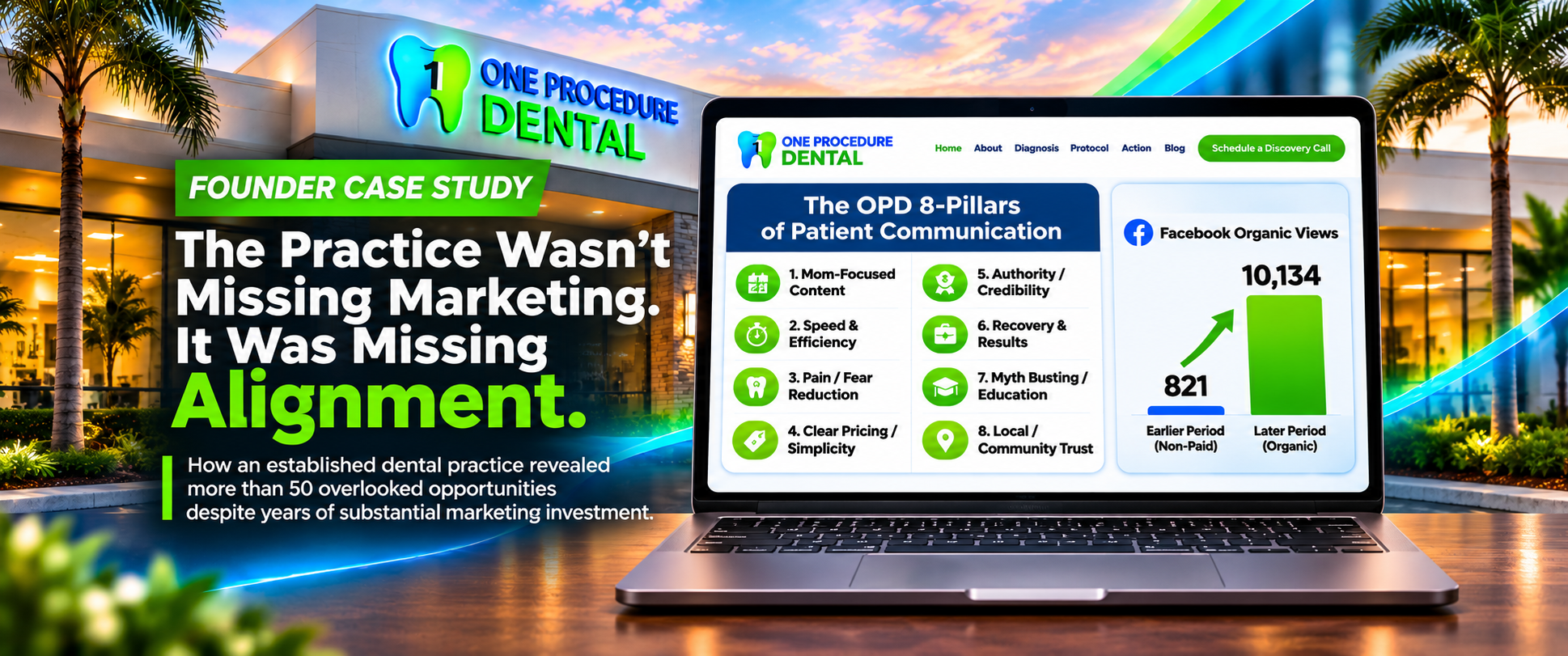
An earlier Facebook report showed 8,074 total views, but 7,253 of those views came from a paid advertising campaign.
That left approximately 821 non-paid views in the earlier reported total.
A later report documented 10,134 organic Facebook views, with no additional paid advertising expenditure reported during the engagement.
Those figures represent different historical reporting periods, so they shouldn't be interpreted as a verified percentage growth rate.
Nevertheless, they illustrate the substantial organic visibility recorded after the organization began restoring consistent activity and introducing more coordinated, patient-centered content.
Other social media reporting also showed increased visibility and engagement. Staff members provided encouraging feedback and relayed that patients had noticed the organization's renewed social media presence.
These observations were particularly meaningful because the practice was already well established.
We weren't trying to introduce an unknown provider to the market.
We were working to help an established organization make better use of the reputation, visibility, and clinical strengths it already possessed.
The Bigger Lesson: More Marketing Doesn't Fix a Broken Foundation
One analogy I often use is painting over a damaged wall.
You can spend considerable money applying another coat of paint. The surface might temporarily look better.
But if the underlying problems haven't been addressed, adding more paint doesn't solve them.
Marketing can work the same way.
A practice can invest in advertising, social media management, website development, and promotional campaigns while fundamental inconsistencies remain unresolved.
Broken connections, outdated information, unclear messaging, weak differentiation, and unanswered patient questions can continue affecting the experience of prospective patients.
In this engagement, the most striking discovery was that more than 50 issues and overlooked opportunities existed inside an already high-performing dental organization.
The practice had invested heavily in marketing, yet many of these foundational issues had remained unaddressed.
By identifying those problems, developing a coordinated Protocol, and participating directly in implementation, we helped bring greater consistency and purpose to the organization's digital presence.
The subsequent improvements in reported organic visibility and engagement reinforced the value of examining the foundation before recommending additional marketing expenditure.
Conclusion: What Might Be Hiding Inside Your Practice?
This experience reinforced something I've observed throughout more than two decades working with healthcare professionals.
A successful practice can still have an underperforming procedure, overlooked market opportunities, or significant gaps in how it communicates with prospective patients.
The wisdom tooth practice in this case already had strong visibility, substantial clinical experience, and patients traveling nationally for treatment.
Its opportunity wasn't to manufacture credibility or invent new competitive advantages.
Those strengths already existed.
The opportunity was to identify what wasn't working, correct inconsistencies, communicate those advantages more effectively, and create a more connected experience for prospective patients.
That is the thinking behind One Procedure Dental.
Today, OPD helps general dentists examine one procedure they would like to grow, understand the opportunities within their practice and local market, and develop a customized Protocol for moving forward.
We aren't a traditional marketing agency, and we don't begin by recommending another advertising campaign.
We begin with a diagnosis.
Because before you spend another dollar marketing a procedure, it's worth understanding what's actually standing in the way.
If more than 50 overlooked issues could be identified inside an already successful dental organization, what opportunities might be hiding inside yours?
One Procedure Dental — Diagnosis → Protocol → Action.
Which procedure would you most like to grow?
Schedule a Discovery Call at www.oneproceduredental.com.
About this case study: This article describes a healthcare consulting engagement performed by the founder of One Procedure Dental before OPD was established. The organization has been anonymized. Historical social media figures are reported with their available context and do not establish patient booking or revenue outcomes.