When was the last time you visited your dental practice's website and looked at it from the perspective of a potential patient? Not as the practice owner, not as the dentist who knows every procedure being performed, but as someone who has never visited your office and is trying to decide whether your practice is the right choice.
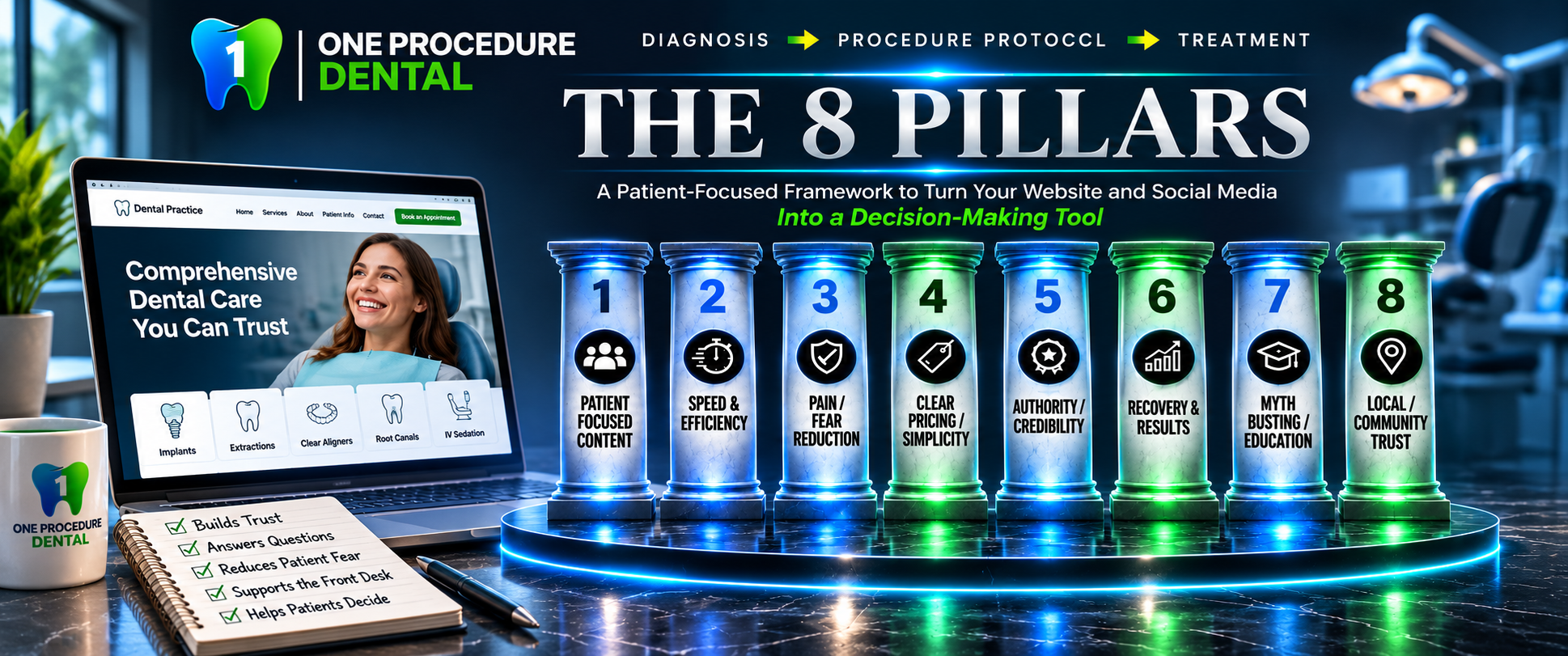
At One Procedure Dental, we developed a concept called the 8 Pillars, designed around the questions potential patients may have when researching dental procedures online. The idea is simple: give dental practice owners and solo practitioners a practical way to evaluate their websites and social media by asking one important question: Are we providing the information patients need to feel comfortable making a decision?
Most dental websites do a reasonable job of listing services, introducing the dentist and staff, and providing contact information. But patients are often looking for much more than a list of procedures. They may have concerns about pain, recovery, cost, experience, treatment options, or whether they can trust the practice. When that information is missing, patients are left searching for answers elsewhere.
The OPD 8 Pillars were developed to help identify those information gaps and provide a framework for improving how dental practices communicate with their communities. They can also serve as a practical scorecard, allowing dentists to take a closer look at their existing digital presence before investing additional money in marketing.
Why These Eight Pillars Matter
Think about how people research products and services today. They search online, compare options, read reviews, visit websites, and often explore social media before contacting a business. Dentistry is no different, although the decisions patients make can involve considerably more uncertainty, especially when treatment includes surgery, sedation, financial commitments, or concerns about recovery.
Depending on the procedure, patients may have several questions before they ever consider scheduling an appointment. They want to know what the treatment involves, whether it will hurt, how long it takes, what it might cost, and whether the dentist has the experience necessary to provide the care they're seeking. The purpose of the 8 Pillars isn't to suggest that every patient will ask every question. Instead, it's to help practices anticipate common concerns and make relevant information easy to find.
When a dental website and social media work together to address those concerns, patients have a better opportunity to become informed and confident about their next steps. This is particularly important when practices are trying to grow specific procedures, because patients researching dental implants, wisdom teeth removal, clear aligners, or root canal therapy may have very different priorities and concerns.
Understanding the OPD 8 Pillars
Pillar 1: Patient-Focused Content
Patients aren't necessarily interested in technical descriptions of dental procedures. They're interested in understanding how a treatment may help them, what problems it addresses, and what the experience might involve. Patient-focused content communicates in language people understand, answers practical questions, and helps visitors recognize whether a particular service may be appropriate for their needs. An effective dental website should communicate with patients rather than simply describe the procedures a practice performs.
Pillar 2: Speed & Efficiency
Time matters to patients. They want to understand how long a procedure takes, whether multiple appointments are required, how quickly they can be evaluated, and what the overall treatment process looks like. Providing realistic expectations about scheduling, appointment duration, and treatment timelines can help reduce uncertainty and make planning easier. Practices that communicate these details clearly can help patients understand how treatment may fit into their schedules and daily responsibilities.
Pillar 3: Pain & Fear Reduction
Dental anxiety is a genuine concern for many patients. Some worry about discomfort during treatment, while others fear injections, sedation, surgery, or complications. A dental website has an opportunity to explain how the practice addresses patient comfort, what pain-management or sedation options may be available, and what patients can expect before, during, and after treatment. Addressing these concerns directly can help patients feel more comfortable discussing their treatment options rather than avoiding care because of unanswered questions.
Pillar 4: Clear Pricing & Simplicity
One of the most common unanswered questions involves cost. While insurance coverage, clinical needs, and treatment complexity can influence final pricing, practices can still provide helpful information about typical price ranges, financing options, and the factors that affect treatment expenses. Clear explanations of the consultation and payment process can make an unfamiliar experience feel more manageable. Patients don't necessarily expect an exact price before an examination, but providing realistic financial information can reduce uncertainty and make the decision to contact a practice easier.
Pillar 5: Authority & Credibility
Patients want to know whether they can trust the person providing their care. Information about professional experience, relevant training, clinical capabilities, and the practice's approach to treatment can help establish credibility. Rather than relying on unsupported claims about being the best, dentists can communicate their qualifications and experience in a way that helps patients make informed decisions. A practice that performs certain procedures regularly or has invested in additional clinical education should consider how that information is communicated to prospective patients, while ensuring all claims are accurate and appropriate.
Pillar 6: Recovery & Results
For many procedures, the questions don't end when treatment is completed. Patients may want to know how long recovery takes, whether they can return to work, what restrictions might apply, and what results they can reasonably expect. Providing general recovery guidance and realistic information about treatment outcomes helps patients prepare for the experience, while making clear that individual results and recovery times can vary. This is particularly important for surgical procedures, where understanding the recovery process may influence when and how patients decide to proceed with treatment.
Pillar 7: Myth Busting & Education
Dental procedures are often surrounded by misconceptions, outdated information, and stories patients have heard from friends, family, or social media. Educational content provides an opportunity to address common misunderstandings and explain treatment options accurately. Whether discussing wisdom teeth, dental implants, root canals, or sedation, helping patients separate facts from misconceptions can reduce confusion and encourage more informed conversations. A dental practice's website and social media can become valuable educational resources when they consistently address the questions patients are already asking.
Pillar 8: Local & Community Trust
Dentistry is a community-based profession, and patients often want reassurance that they're choosing a practice with a positive local reputation. Community involvement, authentic patient experiences, professional relationships, and consistent communication can all help demonstrate the practice's connection to the people it serves. A website may introduce the practice, while social media can expand that relationship by showing the people, activities, and values behind it. Patients may feel more comfortable contacting a practice when they recognize its involvement in the surrounding community and can better understand the people responsible for their care.
Your Dental Website and Social Media Should Work Together
One of the important considerations behind the 8 Pillars is recognizing that patients don't necessarily rely on a single source of information. A potential patient may discover your practice through Google, visit your website, read online reviews, and then explore your social media accounts before deciding whether to contact the office. Each interaction provides another opportunity to answer questions and build confidence.
Your website might explain a procedure, discuss pricing, and outline recovery expectations, while your social media can provide additional education, introduce team members, demonstrate your involvement in the community, and reinforce your practice's credibility. When these platforms communicate consistently, patients can develop a more complete understanding of the practice. When important information is missing or inconsistent, however, potential patients may continue searching for another provider.
The objective isn't to publish endless amounts of content or repeat the same information everywhere. It's to make sure patients can find meaningful answers through the channels they're already using. For a practice looking to grow a specific procedure, this means evaluating whether its website and social media communicate the experience, education, and information patients need when researching that particular treatment.
Think About Your Front Desk
Here's another reason I believe the 8 Pillars deserve attention. Imagine a potential patient calling your practice with five or six questions about a particular procedure. They want to understand the cost, recovery process, sedation options, appointment availability, and whether the dentist regularly performs that treatment. Your front desk team now has the responsibility of answering those questions, explaining the process, and helping the caller determine whether scheduling a consultation makes sense.
That's an important part of the patient experience, but it also takes time, especially when staff members are managing appointments, insurance questions, and patients already in the office. Now consider what happens when the patient calls during a particularly busy period. What if the call goes unanswered, they're placed on hold, or they reach voicemail? There's no guarantee that person will call back. They may simply return to Google and continue researching other practices.
A well-informed dental website can help address many of these questions before the first phone call. It doesn't replace your front desk team or the personal attention patients deserve, but it can make those conversations more productive. When patients already understand the basics of a procedure, staff members can spend less time repeating general information and more time addressing individual concerns and helping patients take the next step. This is an opportunity that extends beyond dental marketing. It's also about improving communication and supporting the people who interact with patients every day.
Using the 8 Pillars as a Dental Practice Scorecard
One of the reasons we developed the OPD 8 Pillars was to give dental practices a straightforward way to evaluate their existing websites and social media. Before making major changes or investing additional money in advertising, I believe it's worth examining whether the information patients are already finding is actually helping them.
Start by selecting a procedure you currently offer or would like to grow. Then review your website as though you were a patient researching that procedure for the first time. Can you easily find information about the treatment? Does the website address common fears and concerns? Are pricing considerations explained? Can you understand what recovery might involve? Does the practice communicate relevant experience and provide reasons to feel confident about scheduling an appointment?
Next, visit your social media accounts. Do they reinforce the information presented on your website? Are you educating patients, answering common questions, and showing what makes your practice different? Or are you primarily publishing general announcements, holiday greetings, and occasional photographs? You may discover that your practice already addresses several pillars effectively while others receive very little attention. That's valuable information because it helps identify specific opportunities for improvement rather than assuming the solution is simply more advertising.
At One Procedure Dental, our approach begins with understanding the opportunity before recommending a course of action. Our Diagnosis → Procedure Protocol → Treatment framework reflects that philosophy, and the 8 Pillars provide another way to examine how a procedure is communicated to the patients and communities a practice hopes to reach.
For another perspective on evaluating your practice's online presence, read our related article, Your Dental Website Lists Your Services. But Does It Actually Sell Them?
One Final Question for Dentists
If you're a dentist reading this, I'd encourage you to take another look at your website and social media. Not necessarily to redesign everything or spend more money, but to evaluate the experience from the perspective of someone who knows very little about your practice. Think about a patient who is nervous about a procedure, concerned about pricing, uncertain about recovery, or simply trying to determine whether you're the right dentist for their needs.
Are you providing the information that person is looking for, or are you expecting them to call your office to discover the answers? In a competitive dental market, the information patients find online can influence their perception of your practice long before anyone speaks with them. Every unanswered question represents an opportunity to improve how you communicate, educate, and build trust.
The OPD 8 Pillars aren't about making every dental website look the same. They're about helping each practice communicate its strengths, address patient concerns, and provide meaningful information that supports better decisions.
If your website and social media aren't answering the questions patients are asking, imagine how a potential patient feels.